Loyola University Medical Center hosts candlelight ceremony to commemorate donors
April 19, 2026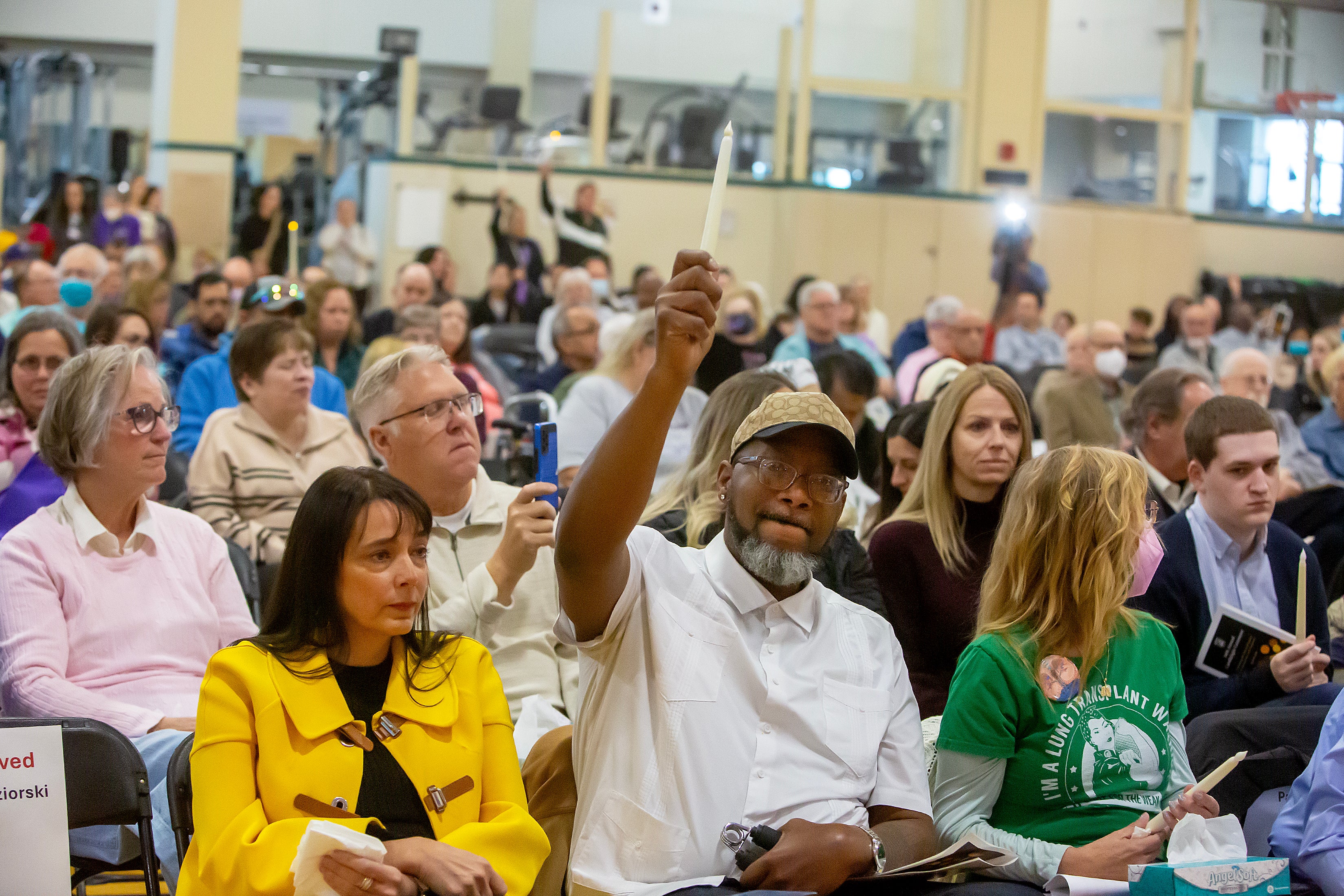
CONTACT:
Allison Peters
allison.peters@luhs.org
708-216-5500
MAYWOOD, IL – On Sunday, April 19, in recognition of Donate Life Month, Loyola University Medical Center hosted its 34th annual candlelight ceremony in honor of organ and tissue donors, their families and countless health care team members. Loyola Medicine colleagues gathered with transplant recipients, their families and donor families to remember those who gave the gift of life and encourage others to become organ donors.
The event featured speakers, including Loyola transplant recipients:
Lung transplant recipient Rosemary Woods, 64, was born with cystic fibrosis. She was diagnosed at six months old, and doctors told her parents she would not live past three. She received her lung transplant at age 57 on April 23, 2019.
Woods has been in touch with her donor’s family for years. “When I met them, I told them I don’t know how to justify my overwhelming joy with your overwhelming grief.”
Members of her donor’s family attended the ceremony with Woods, including her donor’s father who spoke about his daughter and Woods.
Kidney and liver transplant recipient Jill Plesha is a 45-year-old mother of two who owns her own business. Plesha went to the emergency room after she was having trouble using her legs. Doctors told her that she had liver and kidney failure. She received dialysis for 9 weeks and was told she would need a liver and a kidney transplant, which she says she was in “complete denial about.”
A MELD (Model for End-Stage Liver Disease) score is used to assess the severity of chronic liver disease. Her liver was 39/40, the highest level of severity. She received her transplant on November 12. Recovery wasn’t easy, but she was determined to get back to her normal life.
At a follow-up appointment a few months after surgery, one of her coordinators handed her a letter from her donor’s mother. Plesha learned that her liver and kidney came from a 23-year-old mother of two young children. She decided to call the donor’s mother. Plesha is meeting her donor’s mom, brother and grandmother at the candle lighting. “I’m feeling survivor’s guilt, but I’m happy that I’m doing it and I’m doing it for her and her mom,” said Plesha. “I don’t know what to expect, but I feel lucky that she wants to meet me. I’m forever grateful. I wake up every day, and I think about her and her family.”
Living kidney donation recipient Kolleen Monahan Sarns, 48, is a musician who was diagnosed with kidney reflux at 18 months old. A series of surgeries in her childhood kept her kidneys functional until she began experiencing kidney infections again. In May 2024, Sarns was diagnosed with end-stage renal disease and told she would need a transplant to survive. With the help of Loyola, Sarns created a microsite to help in her search for a donor.
Finding a living kidney donor has been an interesting journey. “It’s my dad’s brother's first ex-wife's old neighbor's son’s wife,” said Sarns. “She saw my site and was willing to donate.”
This willing donor was not a match, but she volunteered to donate her kidney to a stranger to help Sarns receive a kidney via the “voucher program”. Two days after the donor’s surgery, Sarns received a call that there was a match for her. She received her kidney transplant on July 23. She is back to playing the bagpipes, which she played at the event.
“I tell everyone it was such an amazing experience that I don’t wish anyone to go through,” said Sarns. “It was such an amazing experience because it showed the positives that are still out there. The people who are willing to donate their kidneys for strangers are just amazing.”
Heart transplant recipient Leroy Porter, 53, had been living with congestive heart failure for years. In November 2018, he suffered a stroke. Following his recovery, his heart had worsened, and he was placed on the transplant list. While in the hospital, Porter got a call that a heart was available. He was in disbelief, “I was on bed rest for so long, all this time spent in hospitals, and I finally felt some relief.”
He received his transplant in February 2020. Porter has been doing well since his transplant and is working on a book about his journey called “I Am Down, But I’m Not Done.”
The importance of organ donation
As of March 2026, over 104,000 individuals in the United States are in need of life-saving organ transplants. In 2025, the U.S. achieved a record for organ transplants for the fifth consecutive year, with 49,064 organ transplants performed nationwide, according to UNOS, a non-profit organization that manages the nation's organ transplant system.
Living donations continued to grow in 2025, with 7,237 people becoming living organ donors, a 3% increase over the previous year, according to new data from the Organ Procurement and Transplantation Network. For the first time in more than a decade, deceased donations dipped, decreasing by 2.5% with 16,550 deceased donors giving the ultimate gift of life.
One person can save up to eight lives as an organ donor, heal more than 75 lives as a tissue donor and restore sight for two people. Nearly 60% of adults and children waiting for a life-saving organ transplant are from minoritized communities.
About the Loyola Medicine Transplant Center and Living Donor Program
The Loyola Medicine Transplant Center provides expert care for heart, lung, kidney, liver, pancreas, and bone marrow and stem cell transplants, including multi-organ transplants. In 2025, Loyola Medicine performed 349 transplants, and the Living Donor Program had more than 58 participants. Experts in surgery, nutrition, social work, financial coordination, physical therapy and psychology work together to guide patients and donors through the transplant process.
The event also featured ambassadors from Gift of Hope, who coordinate the organ and tissue donation process and provide education about the importance of organ and tissue donation to the public and health care professionals in Illinois and northwest Indiana. Since 1986, their efforts have saved the lives of more than 29,000 organ transplant recipients and improved the lives of hundreds of thousands of tissue transplant recipients.