Scholarly Activity
Brumlik Resident Research Symposium
Every academic year culminates in the Brumlik Symposium, held during the day of our evening graduation ceremony. The symposium is named after Dr. Joel Brumlik, MD, the first Chairman of Neurology at the Stritch School of Medicine at Loyola. Groups of residents present quality improvement projects that they have worked on throughout the academic year. The goal of the symposium is to provide a "built in" research experience during residency and also to have real and palpable impact on the culture and policies of the hospital they work in. Projects in the past have focused on medical education, transitions in care, patient safety, medication reconciliation, clinical efficiency and patient satisfaction. In addition to a "local" impact, the target for all projects is publication in peer-reviewed journals, presentation at national level meetings, and submission for the AAN Safety and Quality Award presented at the National Meeting.
National Conferences and Professional Meetings
National, regional, and local academic conference attendance is encouraged and residents often present posters at national meetings. Residents receive an annual stipend that accumulates for the purpose of financial assistance when attending conferences.
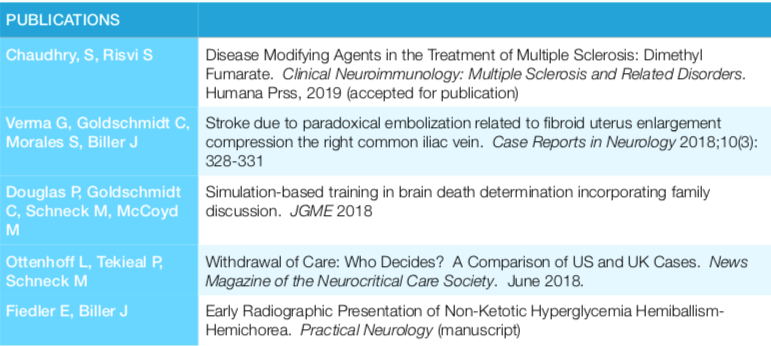
Recent Resident Publications

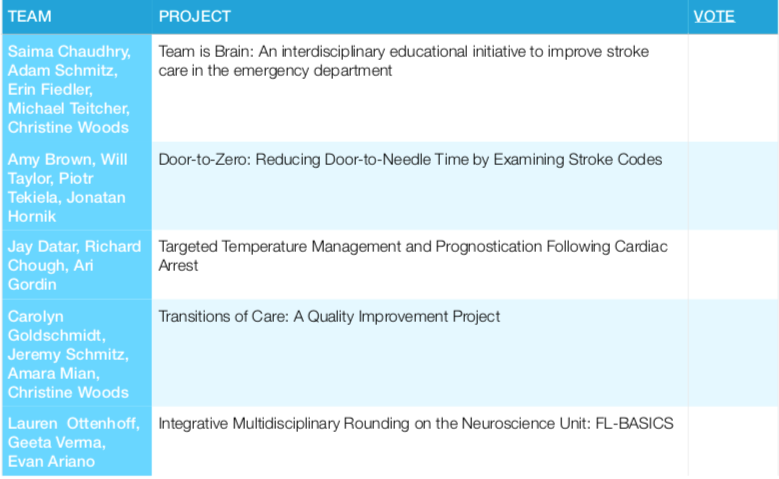
Recent Brumlik Symposium Presentations
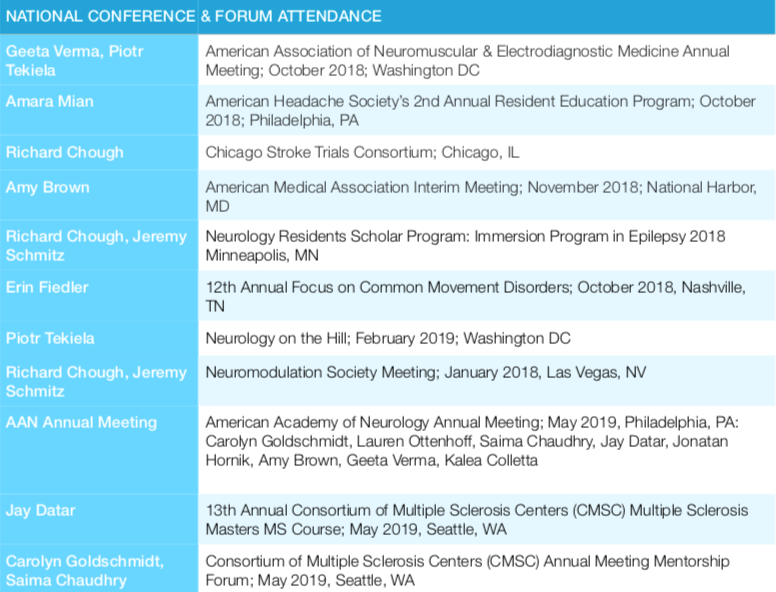
Recent National Conference and Forum Attendance
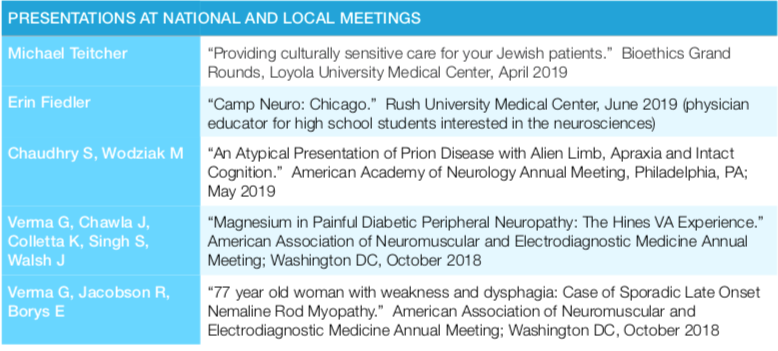
Recent Presentations at National and Local Meetings

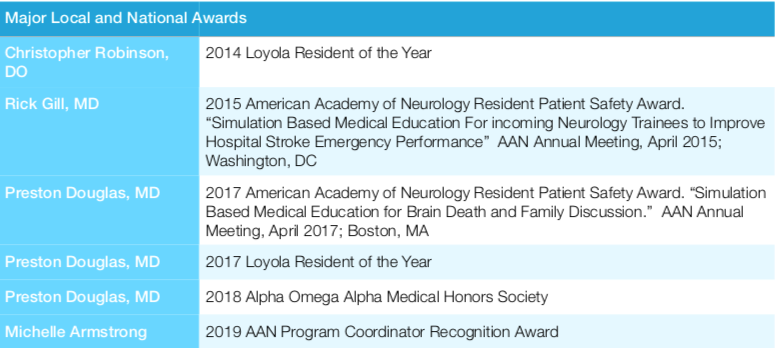
Recent Awards and Recognitions (Local and National)
Dr. Adam Wadina (Neurology PGY 3), was nominated by the SSOM as Resident Of The Year 2022.
Publications and Awards
Sergej Stjepic OMS-II, Bradley Boget OMS-II, Dr. David Dufeau PhD, Dr. Garren Gebhardt DO, (2018). Aesculapius: Adding a Dimension of Instruction Through Integrating Spatial Knowledge.
A publication
Siemionow M, Strojny MM, Kozlowska K, Brodowska S, Grau-Kazmierczak W, Cwykiel J. Application of Human Epineural Conduit Supported with Human Mesenchymal Stem Cells as a Novel Therapy for Enhancement of Nerve Gap Regeneration. Stem Cell Rev Rep. 2022 Feb;18(2):642-659. doi: 10.1007/s12015-021-10301-z. Epub 2021 Nov 17. PMID: 34787795; PMCID: PMC8930890.
Siemionow M, Brodowska S, Langa P, Zalants K, Kozlowska K, Grau-Kazmierczak W, Heydemann A. Long-Term Biodistribution and Safety of Human Dystrophin Expressing Chimeric Cell Therapy After Systemic-Intraosseous Administration to Duchenne Muscular Dystrophy Model. Arch Immunol Ther Exp (Warsz). 2022 Aug 17;70(1):20. doi: 10.1007/s00005-022-00656-7. PMID: 35978142; PMCID: PMC9385806.
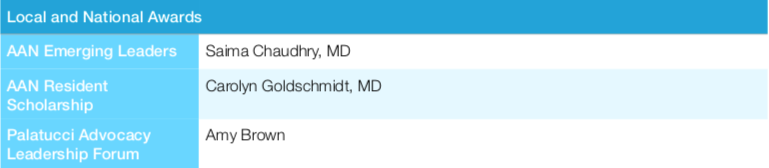
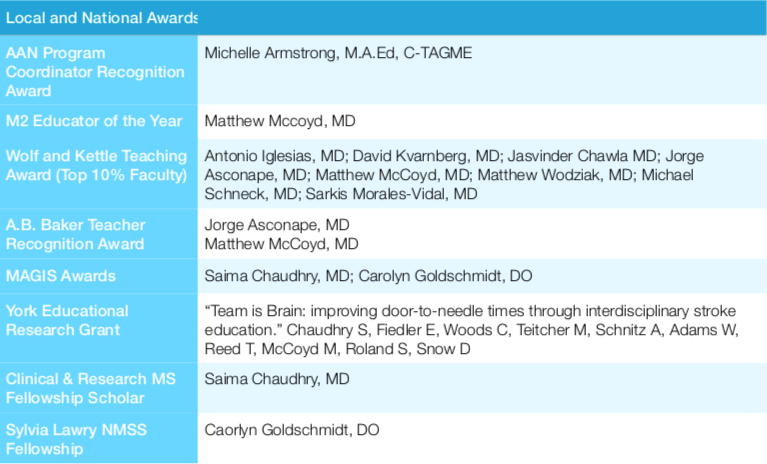
All-Time Major and National Awards (2014-2019)
The Neurology of Systemic Diseases
Volume 20, Issue 1, January 2020
Transcranial Magnetic Stimulation as Treatment in Multiple Neurologic Conditions. Antonio H. Iglesias
Volume 20, Issue 8, August 2020
Acute Neurological Complications of Brain Tumors and Immune Therapies, a Guideline for the Neuro-hospitalist. Jigisha P. Thakkar, Vikram C. Prabhu, Stasia Rouse, Rimas Lukas
Volume 20, Issue 12, December 2020
Central Nervous System Manifestation Associated with COVID-19
Afshin A. Divani, Sasan Andalib, José Biller, et al.
Volume 21, Issue 1, January 2021
Immune-mediated disorders affecting the spine and the spinal cord.
Jorge G Ortiz Garcia, Gina S. Perez Giraldo
Volume 21, Issue 3, March 2021
Peripheral nervous system complications associated with Coronavirus (COVID-19). Sasan Andalib, Jose Biller, Mario Di Napoli, Afshin Divani.
Volume 21, Issue 9, June 2021
The Neurological Manifestations of Post-Acute Sequelae SARS-CoV-2 infection. Narges Moghimi, Rahul Shekhar, José Biller, et al.
Volume 22, Issue 1, January 2022
Granulomatous diseases of the central nervous system. Braden Dasovic, Ewa Borys, Michael Schneck
Volume 22, Issue 8, August 2022
The Neurology and Psychopathology of Pica.
Eugene Schnitzler
Volume 23, Issue 8, August 2023
Neuroinflammation in Acute Ischemic and Hemorrhagic Stroke.
Diana L. Alsbrook, Mario Di Napoli, Kunal Bhatia, José Biller, Sasan Andalib, Archana Hinduja, Roysten Rodrigues, Miguel Rodriguez, Sara Y. Sabbagh, Magdy Selim, Maryam Hosseini Farahabadi, Alibay Jafarli & Afshin A. Divani
Volume 23, Issue 5, May 2023
Contemporary Antiplatelet and Anticoagulant Therapies for Secondary Stroke Prevention: A Narrative Review of Current Literature and Guidelines. Kunal Bhatia, Lindsey M. Ladd, Kelsey H. Carr, Mario Di Napoli, Jeffrey L. Saver, Louise D. McCullough, Maryam Hosseini Farahabadi, Diana L. Alsbrook, Archana Hinduja, Jorge G. Ortiz Garcia, Sara Y. Sabbagh, Alibay Jafarli & Afshin A. Divani
Volume 24, Issue 12, December 2023
An Overview of Laryngologic Manifestations of Neurologic Diseases.
Colton Wolf, MD, Behzad Elahi, MD, Steven J. Charous, MD
Volume 25, Issue 1, March 2025
Common acute and chronic neurological complications of brain tumors and brain tumor treatments. Dr. Jigisha Thakkar
Volume 25, Issue 1, October 2025
Systemic Manifestations of Status Epilepticus.
Dr. Antonio Iglesias
Volume 25, Issue 1, April 2-25
Artificial Intelligence (AI) in Vascular Neurology: Applications and Challenges – A Review of AI Tools in Stroke Imaging, Clinical Decision-Making, and Prediction Models for Outcomes. M Alqadi, Sarkis Morales-Vidal, MD
Volume 25, Issue 1, May 2025
Systemic Factors Influencing Outcomes in Endovascular Thrombectomy for Acute Ischemic Stroke. Brandon Bond
Volume XX, Issue X, 2026
Behavioral Neurology of Systemic Diseases: Mechanisms, Phenotypes, and Clinical Implications. Sarkis Morales, MD