
Testing for cervical cancer: PAP and HPV screening
April 28, 2026
Pap tests and HPV tests are essential tools in preventing cervical cancer, yet many patients are unsure how these screenings differ or when each one is needed. Understanding the purpose of both tests and how they work together can help patients feel more confident, informed and prepared for their care.
What is a Pap test and is it necessary?
A Pap test is a screening test that checks for cervical cancer. The disease usually develops slowly over time as healthy cells in the cervix start to change into abnormal cells, a process known as dysplasia. These abnormal cells may eventually become cancer cells and spread further into the cervix and surrounding areas.
Cervical cancer is the only gynecological cancer that can be detected with a screening test, which could be a Pap test, HPV test or both (depending on the situation). Thankfully, when found early, the disease is highly treatable and is associated with a long survival rate and strong quality of life. However, despite this, half of individuals who are diagnosed were not screened as recommended.
“While the Pap test is specifically a cervical cancer screening, just looking at the cervix can sometimes tell us a lot more; things like infection, abnormal discharge or even a cervical polyp,” says Jessica Bender, DO, obstetrician and gynecologist at Loyola Medicine.
What is an HPV test?
Human papillomavirus (HPV) is the leading cause of cervical cancer by a large majority. More than 90% of cases are caused by HPV, almost all of which can be prevented with an HPV vaccination. HPV itself is a virus that infects the skin, genital area and lining of the cervix, spread during unprotected sex with an infected partner. It is the most common sexually transmitted disease in the world.
An HPV test, as the name suggests, takes a sample of cervical or vaginal cells to check if the patient has the infection.
The difference between a Pap test and HPV test
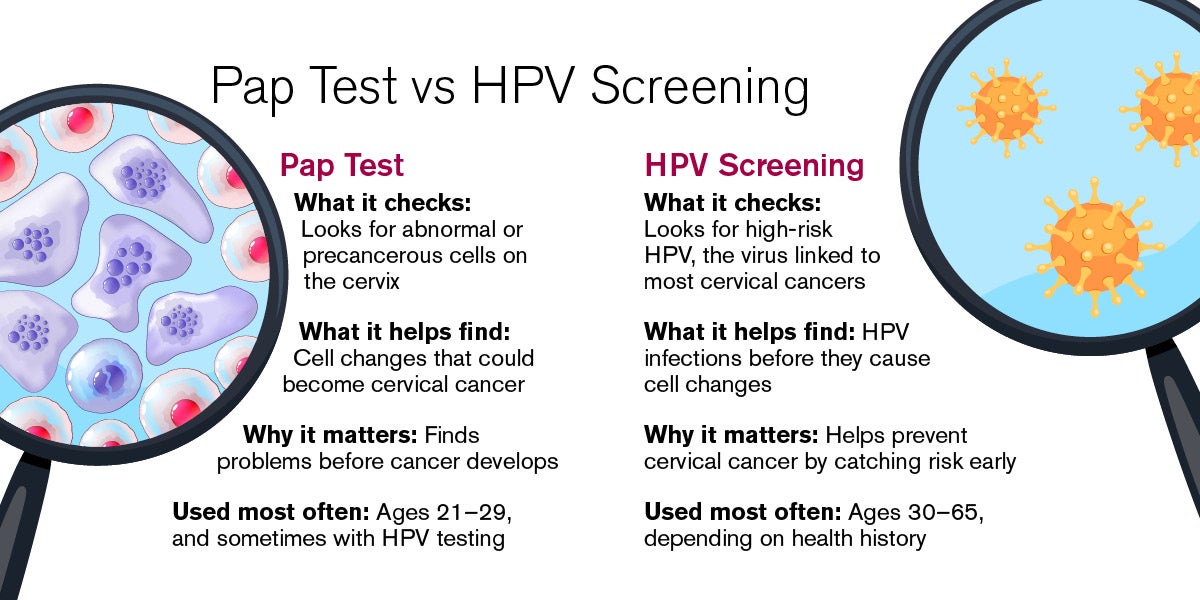
Both a Pap test and HPV test check the cells in the cervix and can be performed at the same time. However, a Pap test looks for abnormal cells that indicate the presence of cervical cancer while an HPV test specifically screens for HPV, looking for strains that are more likely to cause cancer. Unlike a Pap test, an HPV test can be collected from the vagina, even by the patient themselves. However, this option is not right for everyone so your health care provider can help you decide which options are best for you.
What to expect during a cervical cancer screening
Both Pap tests and HPV tests are simple examinations that usually only take a few minutes. However, if you’ve never undergone a cervical screening you may be a little nervous and wondering what the tests will entail. Thankfully, your appointment won’t be as complicated as you may think. Before your exam, consider these general tips to make your experience as easy as possible:
- Try to schedule your exam before or after your period. If bleeding occurs during the exam, the tests may not be able to be sent to a lab.
- Always let the doctor know if anything feels painful. While parts of the tests may feel uncomfortable, neither a Pap test nor an HPV test should cause any pain.
- Don’t have sex at least 24 hours before your appointment. Semen or lubricant can make it more difficult to get a clean cervical sample.
- Don’t be afraid to ask questions. It’s completely normal to be nervous but always remember that the doctor is there to help.
- Don’t worry about shaving or grooming. Neither are necessary for these tests. The doctor cares about the quality of the sample, not your appearance.
If you are very worried about having a pelvic exam, ask your provider if self-collected HPV testing is an option for you. This does need to be done in the office, but your provider can show you how to collect the sample and can leave the room to let you collect it in private.
“For patients who are nervous, especially younger patients or those doing this for the first time, I like to explain everything before they even change clothes. We sit and talk through what the exams involve so there are no surprises,” says Dr. Bender.
Step 1 – Cervical screening preparation
The screening will be performed in a private room. If you would like a friend, family member or staff member in the room to make you more comfortable, simply ask; it will likely be fine with the physician performing the test(s). Before the screening, you’ll be asked to remove your clothing from the waist down and will be provided with a cover sheet or gown.
Step 2 - Pap test and/or HPV test
After the pelvic exam, the doctor will insert an instrument, known as a speculum, into the vagina to help see the cervix. A few cervical cells are then taken from the surface and slightly inside the cervix with a swab which will then be sent to a lab for analysis.
“Neither a Pap test nor HPV test should be painful. You’ll feel pressure, but it’s not supposed to hurt. If something feels uncomfortable, we want patients to speak up,” says Dr. Bender.
Step 3 - Pelvic exam
Before the doctor performs the Pap test and/or HPV test, they will likely perform a pelvic exam. You will lie back on the exam table where the doctor will check for unusual growths, masses, or anything else abnormal in the vagina, cervix or uterus. Generally, this is done by placing an examining finger inside the vagina with the other hand pressing on your stomach.
How often is a Pap test or HPV test needed?
Most people don’t have to worry about cervical cancer screening until they’re 21 years old. Starting at that age, Pap testing is done every three years until age 29, then Pap and HPV are tested together every five years starting at age 30. Another option is HPV testing alone which can start at age 25 and is done every three years if you collect it yourself or every five years if your provider collects it.
Some patients need more frequent screening if they're considered high risk. This may include:
- Immunocompromised patients
- Patients with HIV
- Transplant patients on immunosuppressive medication
- People who have had cervical dysplasia in the past
However, even if a Pap test isn’t due, annual OB-GYN visits are still recommended. It’s an excellent opportunity for patients to learn more about minimizing health risks, ask questions and bring general concerns to the doctor. Patients can also learn about recommended preventive screenings and counseling, taking into account their specific medical history. And unlike visits for injuries and illnesses, these appointments can help with early detection of potential health issues for both physical and emotional well-being.
“I think a lot of patients assume that if their Pap test is normal and they’re low risk, they don’t need to come back for a few years. However, we really want to see patients annually. There are many things we check every year, like breast exams, period concerns and overall health,” says Dr. Bender.