Ophthalmology Residency


Overview of the Ophthalmology Residency Program

The Loyola Medicine – Edward Hines, Jr. VA Hospital Ophthalmology Residency program provides a joint education opportunity offered by the two institutions.
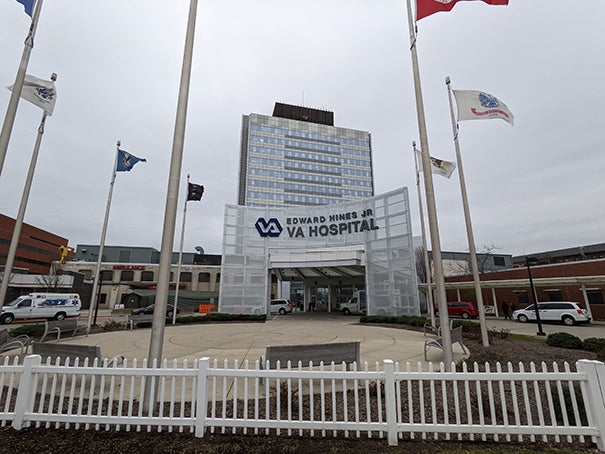
Edward Hines, Jr. VA Hospital

It has trained over 200 ophthalmologists who have contributed to the field as innovators and researchers, to the community as compassionate physicians and to Loyola as alumni educators.

The physician members of the department are faculty members of Loyola University Chicago's Stritch School of Medicine (SSOM) and Edward Hines, Jr. VA Hospital.

The program takes pride in its tradition in excellence. Over the past two years alone:

  • Loyola Ophthalmology residents lead in Minimally Invasive Glaucoma Surgery (MIGS) training.
  • Multiple residents have earned the Strich School of Medicine’s (SSOM) Magis Award in patient- and peer-recognized patient care.
  • Residents have been awarded with the prestigious SSOM’s Epsilon Chapter of the Alpha Omega Alpha honor medical society, Chicago-wide resident research 1st Place (Beem-Fisher) awards and nation-wide American Academy of Ophthalmology’s “Best Of” award.
  • Residents have presented at local and national (American Glaucoma Society, American Academy of Ophthalmology and Association of University Professors of Ophthalmology) conferences.

The residency achievements are a result of the Program’s emphasis on mentorship and collaboration. Under Dr. Charles Bouchard’s leadership, the program’s faculty and residents have created technologically unparalleled virtual simulation educational systems, established multi-city online resident didactic curricula, and collaborated with multiple specialties and universities to design a comprehensive approach to resident training and patient care.

The training program utilizes both Loyola Medicine's flagship hospital, Loyola University Medical Center, and the Edward Hines Jr., VA Hospital to provide the formal instruction and patient care experience needed to prepare a physician to successfully complete the examination process offered by the American Board of Ophthalmology (ABO). Successful completion of the examination process gains for the physician certification and benefits of such recognition.

The residency gives the physician access to the body of knowledge required to competently handle a wide variety of clinical problems related to the eye. This is accomplished by guiding the learner through the appropriate textbooks, periodicals, slide teaching sets, hands-on and virtual experiences, consultation and professional development through interaction with the faculty in a one-to-one or small group setting.

Research activities introduce the resident to the procedures and techniques necessary to carry on meaningful and productive exploration of the frontiers of ophthalmology. The Department's and University's Global Missions initiatives offer several opportunities for residents to explore, contribute to and expand different pathways of education and service.

The Department's innovative Ophthalmology Virtual Reality Simulation Lab is a unique resource that provides fundamental and experiential clinical and surgical training. Residents participate in a curriculum that begins with ocular anatomy and physiology and carries into surgery skills training, such as cataract surgery.
Close up of scarf

The latest residency evolution is the Ophthalmology Residency Wellness Program. The program addresses both extrinsic/systems-based and intrinsic triggers with a multi-modal approach to support resident physical, pyschological and professional wellness. The sessions, tools and offerings create an environment in which residents harness and optimize personal strengths.

The 2025 leadership for the Residency Program is:

  • Charles S. Bouchard, MA, MD - John Mulcahy Professor and Chair
  • Anuradha Khanna, MD - Vice Chair, Education,
  • Chief of Ophthalmology, Edward Hines, Jr. VA Hospital
  • Evan Stubb, PhD - Vice Chair, Research
  • Roshni Vasaiwala, MD - Residency Program Director
  • Max Whitmeyer, MD - Co-Chief Resident
  • Alexis Stefaniak-Clark, MD - Co-Chief Resident
  • Kathleen Vandlik - Interim Residency Program Coordinator kavandlik@lumc.edu

Program Competencies

To assure the successful completion of each rotation, supervising faculty works with each resident in developing knowledge and skill in each of six core competencies as identified by the ACGME (The American Council of Graduate Medical Education).

Resident presenting

The competencies are:

  • Patient Care
  • Medical Knowledge
  • Systems-Based Practice
  • Practice-Based Learning and Improvement
  • Professionalism
  • Interpersonal and Communication Skills

Each of these competencies have Ophthalmology-specific Milestones to guide the advancement and preparation of doctors through their residency. The new 2020 Milestones 2.0 are viewable here.

The evaluation tools used by the Ophthalmology Department to assess resident competencies at the completion of each rotation are:

Competency Evaluation Tool Competency Assessed
Written Evaluation of Resident
  • All Six Competencies
Oral Evaluation of Resident
  • Medical Knowledge
  • Practice-Based Learning and Improvement
Progress Notebook (check list)
  • Medical Knowledge
Skills Transfer Manual (check list)
  • Medical Knowledge
Patient Evaluation (of resident)
  • Professionalism
  • Patient Care
360-degree Evaluations
  • Interpersonal and Communication Skills
  • Systems-Based Practice


Faculty Evaluation of Residents

The first year residents will be given special attention by the program director during the first several months to assure appropriate orientation to the program and provide the resident with the opportunity for questions regarding any aspect of the program.

Resident presenting

Faculty members provide feedback to each resident on their service on a daily basis. The clinical and surgical management skills are assessed and appropriate support and encouragement of quality care is provided. Residents have opportunity to discuss different approached to management.

Formal faculty evaluations of all residents take place every 3 months. Evaluation forms (via New Innovations) are completed for each resident by the Service Line Director and supervising attendings. Each resident's ACGME Milestone progress is discussed in a meeting with all the Service Line Directors. The resident is given the opportunity to read through and converse about the evaluation with the Program Director during the Semi-Annual Reviews.

Each resident takes the Ophthalmic Knowledge Assessment Program (OKAP) Exam. The residents discuss the results of the exam with the Program Director. If the results are unsatisfactory, the resident will be given additional help in the areas of weakness. Any resident who has not achieved a satisfactory status after l8 months will be placed on academic probation and may be required to complete an additional 3-6 months of training in order to successfully complete their residency training.

Resident Evaluation of Faculty

All full- and part-time faculty are evaluated by the residents at the end of each rotation on the GME Toolkit (New Innovations Web Monitoring). A copy of the evaluation is electronically submitted to the Attending only after enough evaluations have been accumulated so that all resident evaluations are anonymous. A second copy of the evaluation is kept by the Department Chairman.

Resident Evaluation of Program

Each resident evaluates the program on an annual basis. The Program Director addresses the general areas of deficiency and tries to make changes to address the deficiencies. Evaluations are kept on file. These evaluations are also done anonymously.

Resident Evaluation of Rotation

The residents will evaluate their experience in the following subspecialty rotations in order to improve the training in these areas (via New Innovations):

  • Anterior Segment
  • General Surgery
  • Oculoplastics
  • Pediatrics
  • Posterior Segment

All Evaluations by the Residents, i.e., Evaluation of the Faculty; Evaluation of the Rotation; Evaluation of the Program are anonymous.

How to Apply

The Department of Ophthalmology encourages applications from motivated individuals who desire a collegial atmosphere in which to develop their critical diagnostic, patient management, microsurgical skills and research abilities.

Resident presenting

2025 Interview Dates:

Thursday, December 4, 2025, 7:30 - Noon 
Thursday, December 4, 2025 12:30 - 5:00pm

Friday, December 5, 2025, 7:30 - Noon 
Friday, December 5, 2025, 12:30 - 5:00pm

Loyola University Medical Center accepts exchange visitors sponsored through the Exchange Commission for Foreign Medical Graduates (ECFMG). Applicants must be eligible for a J-1 or J-2 Visa. These are the only visa types supported by our institution.

For information regarding J-1 and J-2 Visas, the Exchange Visitor Sponsorship Program and application process, please visit the following links:

Virtual Open House

To learn more, please download our flyer below.

Download flyer

If you are interested in attending our virtual open house, please use the following link to register.

Register to attend our virtual open house

Featured Videos

Ophthalmology Residency at Loyola Medicine

Ophthalmology Residency Virtual Tour