
What to know about burn treatment and healing
November 26, 2025
Burn injuries are a global health problem, causing 180,000 deaths every year. Even when a burn is non-fatal, they are still a leading cause of disability, disfigurement, trauma and chronic pain. Because most burns happen at home or work, knowing how to respond quickly can make all the difference in recovery, including how to treat them safely and when it’s time to seek medical care.
“One of the concerns with burn injuries is that it’s not just about the initial burn. There are many risk factors that arise during the healing process, such as infection to long-term functional recovery. That’s why early, informed care makes all the difference,” says Robert Bertellotti, MD, a burn specialist at Loyola Medicine.
What are burns?
A burn is any injury to the skin or underlying fat and muscle that is primarily caused by heat. Radiation, electricity, friction, contact with chemicals, hot liquids or solids, sun exposure and flames can all cause a burn.
Types of burns
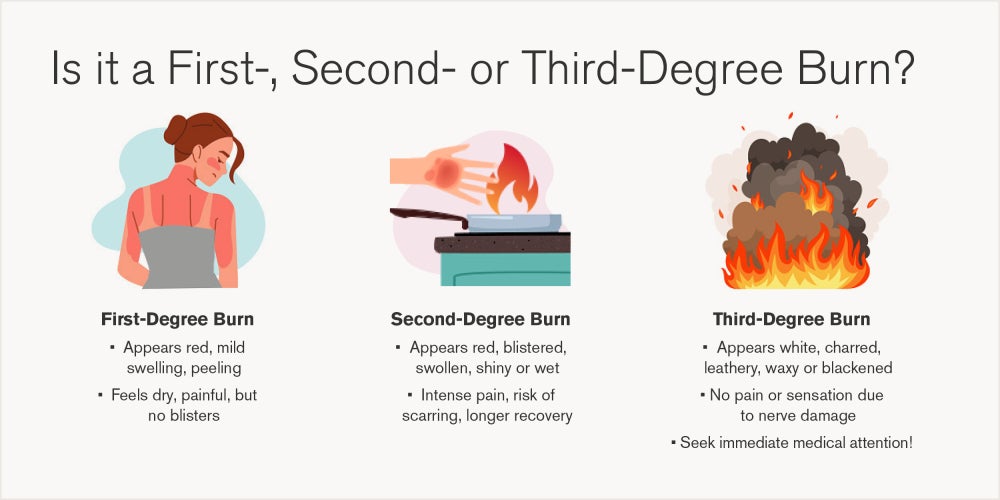
The severity of burns can be dramatically different from one patient to another. There are three types, or degrees, of burns, categorized by how deep the burn has penetrated the skin.
First-degree burns
Only the epidermis, the outermost layer of the skin, is affected by a first-degree burn. If you receive a mild sunburn that appears red, painful, dry and absent of blisters, it’s most likely first degree.
Second-degree burns
When a burn involves the epidermis and the part of the dermis (middle) layer of skin, it’s a second-degree burn. The site will appear red, blistered, swollen, possibly white or discolored and feel painful. Flames, scalds, severe sunburn and chemicals are the most common causes. These also have a higher infection risk, and more serious second-degree burns usually require immediate medical attention.
“There’s definitely some art and skill in determining how deep a second-degree burn is. Sometimes what you see at the moment of injury isn’t what you see three to five days later, when the injury declares itself,” says Dr. Bertellotti.
Third-degree burns
Third-degree burns are the most serious form, significantly injuring or outright destroying all layers of the skin, including the epidermis and dermis, and the layer of fat underneath. In many cases, no pain is felt because nerves are destroyed. As a result, some people may not seek medical care. However, third-degree burns are a medical emergency, and treatment should be sought immediately.
How to treat burns
When a burn occurs, quick and proper care can make a big difference in healing and preventing complications. Milder burns may not be as serious as second or third-degree burns, but they can still be quite painful and leave a scar if not treated.
- Cool the burn by immediately immersing it in cool (not cold) water or apply cool, wet compression. Do this until the pain subsides to a manageable level.
- Remove any clothing, jewelry or other wearable objects near the burn.
- Do not apply creams or other home remedies like butter or honey. If the burn is minor, a thin layer of aloe vera or petroleum jelly can be applied.
- Protect the burn by applying a sterile, non-stick gauze, changing the dressing once a day. Do not wear dressing that has fibers that can get stuck in the burn.
- If the burn is still painful, over-the-counter pain medicine, like ibuprofen and acetaminophen can help.
For small second-degree burns, similar treatments as minor burns can be applied. If you’ve suffered from a serious second degree or any third-degree burn, you must receive medical care immediately.
Third-degree burn treatment
All third-degree burns require medical treatment and cannot be cared for at home. Treatment options depend on the severity of the burn, determined by the amount of surface area that has been affected, and may include:
- Early cleaning and removing dead skin and tissue from the burned area
- Intravenous fluids containing electrolytes
- Antibiotics by intravenous or by mouth
- Pain medications
- Skin grafting
- Functional and cosmetic reconstruction
What is a skin graft?
A skin graft is a surgical procedure used to replace or cover damaged or missing skin by transplanting healthy portions of skin from the patient or a donor to restore appearance or function.
“If a large third-degree burn is left to heal on its own, the body’s natural response is to pull the edges of the wound together, and that’s what causes disfiguring contractures and loss of function. A skin graft helps maintain that space so you keep function,” says Dr. Bertellotti.
When to see a doctor for burn treatment
Most people know when they’ve suffered a serious second degree or third-degree burn. However, there are times where minor burns may require a trip to the emergency room or a burn center. If your burn matches any or all these guidelines, seek medical care immediately.
- The burn is larger than three inches in diameter on your face, hands, feet or a joint
- The burn was caused by an electric shock or a chemical
- There is pus or other fluid leaking from the burn
- The pain gets worse with time
- Some skin was burned away
- The burn smells bad
- The burn hasn’t fully healed after two weeks
“If second-degree burns cover over 5 to 10% of the body or on high-function areas like the face, hands or genitals, then you should be seen at a burn center. Of course, any third-degree burns should be seen by a doctor right away. Otherwise, the biggest concern is keeping the wound infection-free,” says Dr. Bertellotti.
Loyola Medicine Burn Center
With one of the busiest burn centers in the Midwest, verified by the American Burn Association and the American College of Surgeons, Loyola Medicine's specialists have vast experience providing medical and surgical treatments for burns and trauma. Loyola's outstanding success rates and multidisciplinary approach make us a regional leader in burn care.
Our team takes care of some of the most difficult burn cases in the area, and they take special pride in the care they can deliver to their patients.